Hydrogen Bomb: How It Works and When Was It First Used?
What Is A Hydrogen Bomb?
A hydrogen bomb is a bomb that has a higher devastating power than an atomic bomb, which means that hydrogen bombs can annihilate entire cities in a single explosion. These can be called H-Bomb or thermonuclear bombs. The father of the hydrogen bomb is a Hungarian-American theoretical physicist known as Edward Teller (“Edward Teller - Nuclear Museum”). Hydrogen bombs enhance a country’s or base’s defense as an offensive weapon that can be punishing to the opposing forces (Wolk). Nuclear fusion reactions are the ones that make these hydrogen bombs much more stronger. Nuclear fusion weapons have two major components:
The main components of the primary stage are Uranium-235 and/or Plutonium-239.
A separate nuclear fusion secondary stage has a thermonuclear fuel, which are deuterium, tritium, or lithium deuteride. Both deuterium and lithium are hydrogen isotopes, which are crucial for the process of fusion (“Hydrogen Bomb - Definition, Atomic Bomb, Difference between Hydrogen Bomb and Atomic Bomb, and FAQs”).
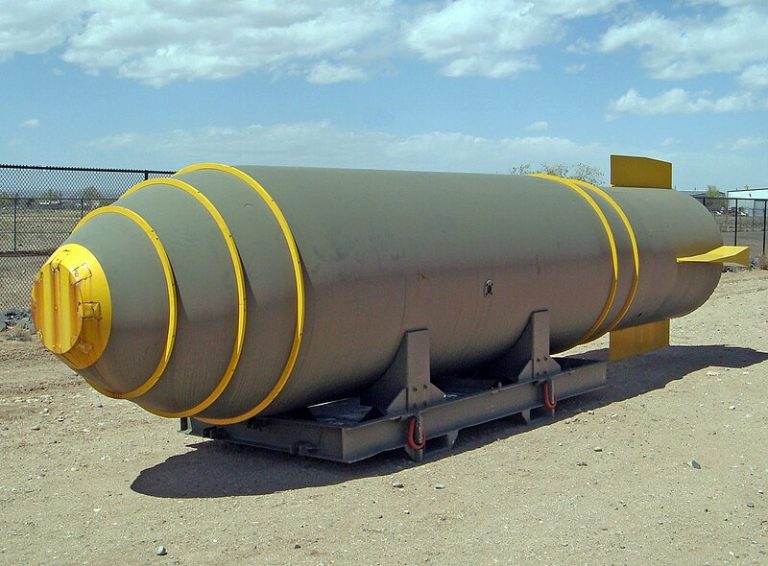 |
Figure 1 Source: Atomic Heritage Foundation. Hydrogen Bomb - 1950 - Mass Produced Hydrogen Bombs. June 19, 2014. https://ahf.nuclearmuseum.org/ahf/history/hydrogen-bomb-1950/ |
When Was The H-Bomb First Used?
The United States tested the first full-scale thermonuclear device on Eniwetok atoll in the Pacific on November 1, 1952 (History.com Editors). The outcome was an explosion similar to one produced by more than ten million tons of TNT. The power of this explosion was around 700 times the power of the uranium fission bomb that was dropped on Hiroshima, Japan (U.S. Department Of Energy). The Soviet Union tested its first “boosted fission weapon” at the Semipalatinsk Test Site in northern Kazakhstan that utilized thermonuclear burning to improve its yield in August 1953, and in November 1955, the Soviet Union tested its first true thermonuclear weapon at the same place, which is Semipalatinsk Test Site in northern Kazakhstan (Sakharov).

Figure 2
The explosion of a hydrogen bomb consists of two stages, which are primary stage and secondary stage.
During the primary stage, uranium that is fissionable is utilized to create a fission chain reaction, This results in explosions and high temperatures of millions of degrees. It can produce an enormous number of radiation that contains a vast amount of neutrons.
In the secondary stage, the heat made in the primary stage supports the fusion reaction and produces a big explosion that blasts the uranium container apart. The whole explosion of a hydrogen bomb only takes place under one second (“Hydrogen Bomb - Definition, Atomic Bomb, Difference between Hydrogen Bomb and Atomic Bomb, and FAQs”).
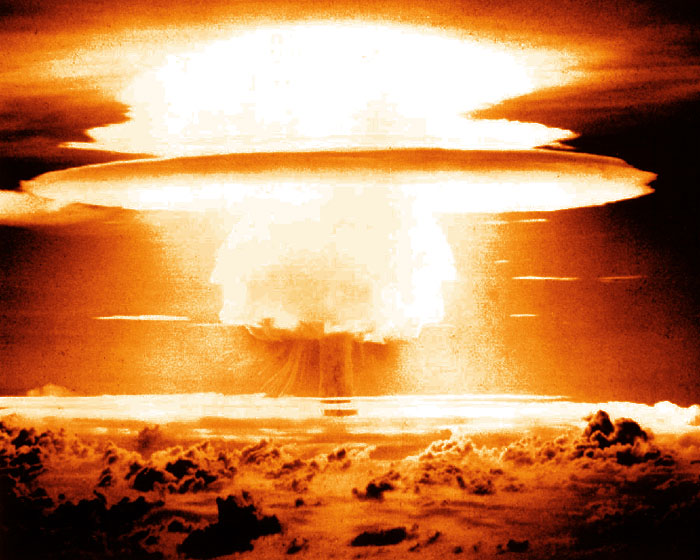
Figure 3
Source: Atomic Heritage Foundation, Hydrogen Bomb - 1950 - Explosion. June 19, 2014. https://ahf.nuclearmuseum.org/ahf/history/hydrogen-bomb-1950/
The very instantaneous impact of a hydrogen bomb explosion is the explosive blast of nuclear radiation that is composed primarily of neutrons and gamma rays. The hydrogen bomb produces blast waves that move outward at very high speeds, which can destroy everything in its path like buildings. The blast waves make overpressures of many pounds per square inch (psi) from numerous miles away from the explosion site. The most widespread damage to buildings happens in an air burst, which is the detonation thousands of feet above the target location. The blast wave from an air burst reflects off the ground that improves its destructive power. A ground burst bulldozes an enormous crater and destroys everything in the immediate vicinity.
At the end, the ozone layer will deplete because hydrogen bombs can add nitrogen oxides and ozone-consuming chemicals in the atmosphere. Without the ozone layer, more ultraviolet radiation would reach Earth’s surface that causes numerous negative effects such as damage in marine life, increased risk of deadly skin cancers and scorching sunburns, and weakening of the human immune system (Wolfson and Dalnoki-Veress). Additionally, the blast kills people close to the point on the Earth’s surface above or below the exploding hydrogen bomb. This can cause lung injuries, ear damage, and internal bleeding further away.
Thermal radiation is so extreme that almost everything close to ground zero is vaporized. The intense heat causes severe burns and burns over a huge area, which fuse into a vast firestorm.
The use of less than 1% of the hydrogen bomb in the world could disturb the global climate and intimidate numerous people with starvation in a nuclear hunger in the long-term. The detonation of thousands of these nuclear weapons could result in a nuclear winter, which would demolish our environment. Hydrogen bombs and nuclear weapons also remove financial support in their development and maintenance. (International Campaign to Abolish Nuclear Weapons).
What Is An Atomic Bomb?
An atomic bomb uses nuclear fission reactions or from the combination of both nuclear fission and fusion reactions, which is where the atomic bomb gets its destructive property from. It is known as A-bomb, atom bomb, nuclear bomb, or nuclear warhead. Regarding its explosion, when the neutron strikes the nucleus of a uranium-235 or plutonium-239 isotope, it causes the atom’s nucleus to divide into two fragments. The series of fissioning neutrons with uranium nuclei multiplies, which causes an explosion (“Hydrogen Bomb - Definition, Atomic Bomb, Difference between Hydrogen Bomb and Atomic Bomb, and FAQs”).
Difference Between Hydrogen Bomb And Atomic Bomb
The H-bomb explodes because of the intense energy released by nuclear fusion reactions while the A-bomb or atomic bomb explodes due to the intense energy released by the nuclear fission reactions. The hydrogen bomb has more destructive potential and has more energy released than an atomic bomb. Hydrogen bombs are also lighter than an atomic bomb but are sophisticated and difficult to make (“Hydrogen Bomb - Definition, Atomic Bomb, Difference between Hydrogen Bomb and Atomic Bomb, and FAQs”).
Conclusion
A hydrogen bomb or H-bomb is a bomb that has a greater destructive power than an atomic bomb. The United States tested the first thermonuclear device on November 1, 1952, and in both August 1953 and November 1955, the Soviet Union tested its first “boosted fission weapon” and its first true thermonuclear weapon at Semipalatinsk Test Site. Hydrogen bombs have a countless number of negative effects such as killing people and destroying our environment. We have covered how the hydrogen bomb works and when it was first used with other necessary information you need to know about.
Comments
Post a Comment